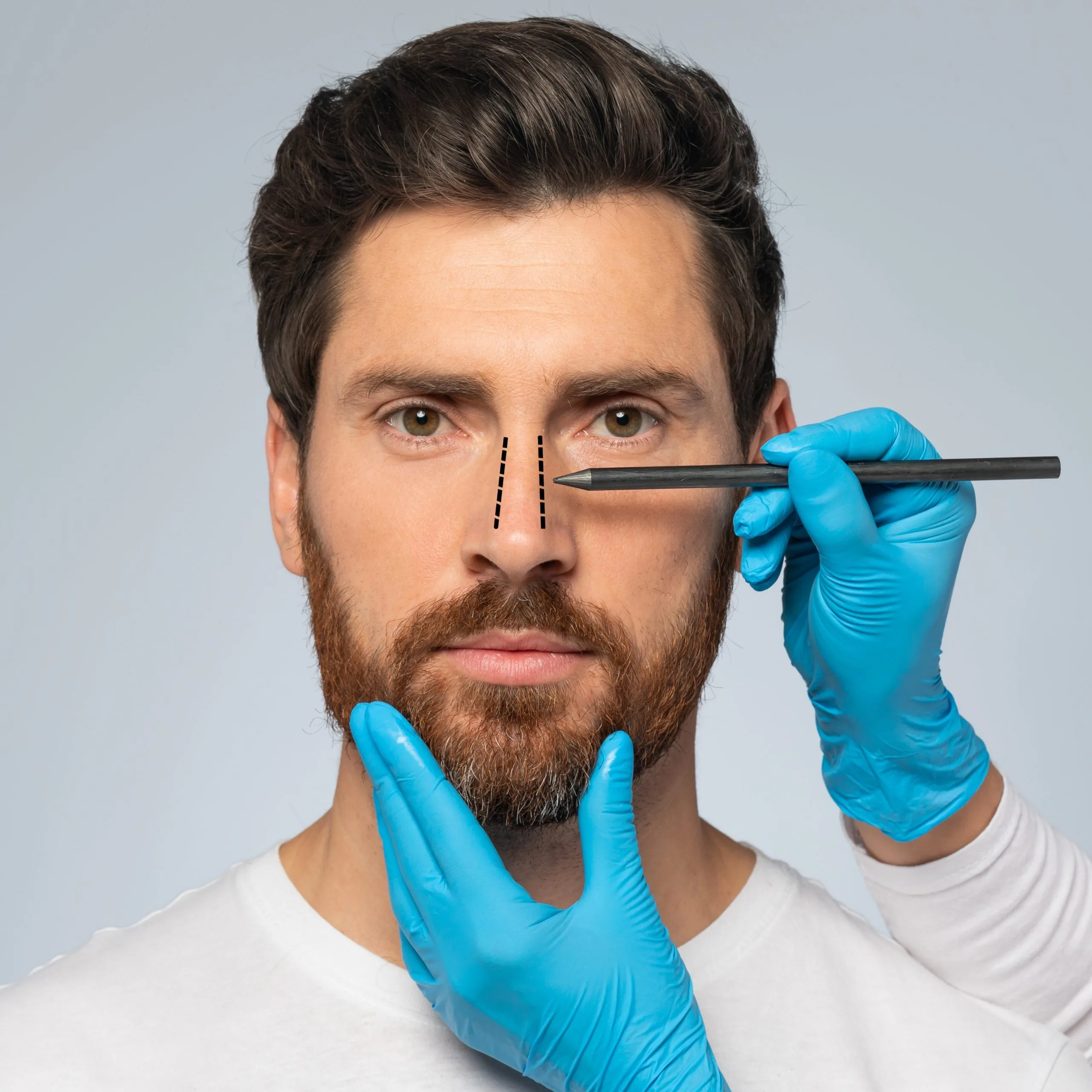
Male rhinoplasty is designed to enhance the appearance and function of the nose while maintaining the strong, masculine features that define your face. Every procedure is customized to your unique anatomy and goals, whether that means smoothing a prominent hump, refining the nasal tip, improving facial balance, or correcting breathing issues. Most patients return to work and other routine activities within one to two weeks, while final results continue to refine and settle over the following months.
At Cilento Facial Plastics in Spring, TX, our team tailors male rhinoplasty to your unique facial structure and goals. This guide walks you through the procedure so you feel informed and confident before you ever step into the operating room.
Male rhinoplasty is a specialized procedure that reshapes the size, shape, and function of the male nose. The nose sits at the center of the face, so even small changes have a big effect. While the surgical principles are similar to any rhinoplasty, the goals are distinct – not a delicate or upturned nose, but masculine features – such as a strong bridge, a well-defined tip, and angles that project confidence.
At its core, this is anatomical artistry that demands a deep understanding of male facial proportions. At Cilento Facial Plastics, the procedure is performed by Dr. Ben Cilento, a plastic surgeon who recognizes that an ideal nose for a man differs fundamentally from that of a woman.
Your journey starts with a private, in-depth consultation with Dr. Ben Cilento at our Spring, TX office:
Discussion of your goals: Describe exactly what bothers you – bumps, crookedness, tip shape, size, and any breathing issues.
Medical history review: Previous surgeries, conditions, allergies, medications, and past nasal injuries. Honesty is vital.
Physical examination: A detailed external and internal examination of skin quality, cartilage, bone, and airway, including assessment for a deviated septum.
Surgical plan discussion: Dr. Ben Cilento explains whether an open rhinoplasty is more appropriate than closed rhinoplasty and why.
Answering your questions: Bring a list – no question is too small.
Learn more on the Dr. Ben Cilento page. To schedule, call (346) 413-9313.
Two to four weeks before:
Stop smoking and using nicotine products: Nicotine constricts blood vessels and compromises healing. Stop cigarettes, vapes, patches, and gum at least four weeks before.
Arrange time off: Plan one to two weeks off work or school; more if your job is physically strenuous.
Arrange help: Ask a responsible adult to drive you home and stay with you for at least the first 24 hours.
One to two weeks before:
Avoid blood-thinning medications and supplements: Including aspirin, ibuprofen (Advil, Motrin), naproxen (Aleve), fish oil, vitamin E, and ginkgo biloba.
Fill prescriptions: Have pain medication and antibiotics ready at home.
Prepare your recovery space: Stock pillows to elevate your head, soft foods, water, and entertainment.
The day before:
Confirm your ride to and from the surgical facility.
Do not eat or drink after midnight, including water – an empty stomach is required for general anesthesia.
Pack your bag: Comfortable, loose-fitting clothes; a button-up or zip-up shirt is ideal.
Dr. Ben Cilento is proficient in both approaches and will select the one that is best for your case.
Closed rhinoplasty: All incisions are made inside the nostrils, leaving no external scar. Suitable for less complex changes, such as a small hump reduction or minor tip work, though it offers a more limited view of the underlying structures. Learn more about closed rhinoplasty.
Open rhinoplasty: Adds one small incision across the columella (the skin between the nostrils) for a direct, unobstructed view of the entire framework. Ideal for correcting significant asymmetries, detailed tip refinement, or most revision rhinoplasty cases. The small columella scar fades to become nearly invisible over time.
Arrival and check-in at the surgical facility, then to the pre-operative area.
Meeting the team: Your nurse and anesthesiologist review your history; Dr. Ben Cilento confirms the plan and makes pre-operative markings.
Anesthesia: General anesthesia keeps you completely asleep and comfortable, with continuous monitoring of heart rate, blood pressure, and oxygen.
The operation: Reshaping bone, sculpting cartilage, and placing grafts as planned – typically two to four hours depending on complexity.
Recovery room: A dedicated nurse monitors you as you wake. You’ll have a splint or cast outside the nose and possibly soft internal splints or packing.
Discharge: Once awake, stable, and comfortable, you go home the same day with your chaperone and detailed post-operative instructions.
Dr. Ben Cilento views the nose as an integrated unit where form and function are inseparable. During surgery, he can simultaneously perform a septoplasty to straighten a deviated septum or address enlarged turbinates or nasal valve collapse.
Correcting these issues can dramatically improve quality of life – easier breathing, better sleep, reduced snoring, and improved exercise tolerance. For many men, the functional improvement is just as satisfying as the cosmetic change.
Your adherence to post-operative instructions directly affects your healing and final result. Patience is key.
Expect grogginess, congestion, swelling, and bruising – particularly around the eyes.
Splint and bandages: An external splint protects the new structure; soft internal splints may support the septum. Typically removed about one week after surgery.
Discomfort: Usually mild to moderate and managed with prescribed medication – more pressure and congestion than sharp pain. Many men are surprised how tolerable recovery is.
Swelling and bruising: Peak around days two to three. “Raccoon eyes” fade over 7–14 days; most swelling resolves over the first few weeks, with residual tip swelling continuing for up to a year or more.
Nasal congestion: Your nose will feel blocked, similar to a bad cold. A humidifier and saline spray (as directed) can help; breathe through your mouth for the first few days.
Days 1–3: The most swelling and bruising. Rest with your head elevated and apply cold compresses.
Week 1: Splint, stitches, and internal splints removed – often a major milestone. Bruising begins to fade. Avoid strenuous activity, bending, or lifting.
Weeks 2–4: Most visible bruising and swelling subside.
Weeks 3–6: Gradually resume more strenuous activity as cleared. Avoid contact sports.
Months 2–3: Breathing improves; about 80–90% of the swelling is gone, and the overall shape is clear, though the tip remains firm.
6 months to 1 year (and beyond): Final tip definition emerges as the last swelling resolves. The nose continues refining for 12–18 months.
Keep your head elevated: Sleep on your back with two to three pillows for at least the first week or two.
Use cold compresses: Apply to cheeks and eyes (not directly on the nose) for the first 48 hours.
Do not blow your nose for at least two weeks; sneeze with your mouth open.
Avoid strenuous activity: No heavy lifting, straining, or intense exercise for at least 4–6 weeks.
Protect your nose: Avoid bumps and don’t wear glasses or sunglasses that rest on the bridge until cleared (usually around 6 weeks).
Stay out of direct sun and use protection, as healing skin is sensitive.
Attend all follow-up appointments so Dr. Ben Cilento can monitor healing; the first is typically one week after surgery.
Questions during recovery? Reach our office at (346) 413-9313.
The hallmark of a well-performed male rhinoplasty is a result that looks entirely natural – like the nose you were always meant to have. This is achieved by:
Respecting masculine aesthetics: A strong, straight bridge and a defined, non-rotated tip aligned with classic male proportions.
Prioritizing harmony: Ensuring the nose fits seamlessly with your chin, jaw, and brow.
Avoiding over-correction: Conservative, precise changes so nothing looks “done,” scooped, or pinched. Dr. Ben Cilento knows that sometimes less is more.
The ideal reaction isn’t “You got a nose job!” but “You look great!” – noticeable but subtle.
Rhinoplasty results are considered permanent – the reshaped bone and cartilage hold their new form for life. Your nose still ages with the rest of your face, and its appearance can shift subtly over decades, but these are gradual, natural changes, not a reversal.
Rhinoplasty is one of the most technically demanding facial procedures. The nose is small, three-dimensional, and central to your appearance, so even tiny adjustments have a large effect.
Dr. Ben Cilento specializes in facial procedures, including the full range of rhinoplasty options – from primary to revision rhinoplasty and ethnic rhinoplasty. A surgeon who works on noses regularly understands the subtle differences between masculine and feminine anatomy and how to plan for thicker skin, breathing issues, and long-term stability.
Choosing the right surgeon is the single most important decision in this process. Take time to review results, ask questions, and make sure you feel comfortable before moving forward.
Male rhinoplasty is a personalized procedure that reshapes the nose to look strong and natural on a man’s face while often improving breathing. From the initial consultation through a recovery of about one to two weeks and final results that develop over roughly a year, understanding each step helps you feel confident and prepared. The keys to a great outcome are realistic expectations, careful preparation, adherence to your aftercare instructions, and choosing an experienced surgeon who specializes in facial surgery.
If you’re ready to learn how male rhinoplasty can help achieve your goals, our team at Cilento Facial Plastics in Spring, TX, is here to help.
Call (346) 413-9313 to get started.
About the Author
Dr. Ben cilento